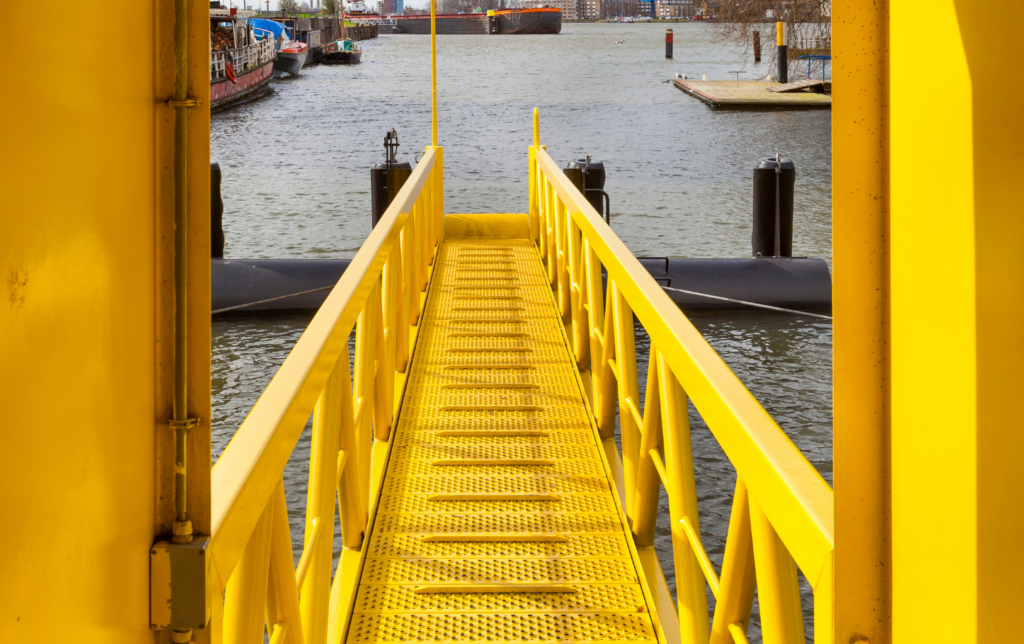
Industrial gangway systems are engineered elevated access structures designed to provide safe, OSHA-compliant movement between platforms, vehicles, vessels, and equipment. They must meet specific slope ratios, load capacities, guardrail height standards, and walking-working surface regulations to reduce fall risk and ensure long-term structural reliability in industrial environments.
Industrial Gangway Systems: The Complete Engineering and Compliance Guide
Industrial gangway systems are not accessory equipment. They are regulated safety infrastructure.
In heavy industry, elevated access is unavoidable. Workers must transition between loading racks and tanker trucks, from platforms to storage tanks, from docks to marine vessels, and across structural elevations inside manufacturing facilities. Each transition introduces fall exposure. Each elevation change introduces structural liability. Each improperly designed access point increases regulatory risk.
Industrial gangway systems exist to eliminate those risks through engineered design. JE Technology Solutions approaches gangway systems as structural safety systems governed by engineering calculation, regulatory compliance, and lifecycle durability. The difference between a fabricated walkway and an engineered gangway system is measurable in load performance, deflection control, corrosion resistance, and compliance assurance. Organizations that understand this distinction reduce injuries, prevent citations, and extend infrastructure lifespan.
What Are Industrial Gangway Systems?
An industrial gangway system is an elevated walking-working surface that connects two separate elevations while maintaining structural stability, fall protection, and regulatory compliance.
The defining characteristic of a gangway system is not simply elevation. It is engineered intent. A properly designed gangway is calculated to support predictable live loads, resist environmental degradation, maintain safe slope geometry, and integrate guardrail protection that meets federal standards.
Under regulations enforced by the Occupational Safety and Health Administration (OSHA), gangways used by employees are classified as walking-working surfaces. That classification carries enforceable obligations. The structure must support its maximum intended load. The surface must remain stable and slip resistant. Open sides must be protected. Structural components must withstand defined force thresholds. When these standards are not met, the gangway becomes a liability rather than a safeguard.
JE Technology Solutions designs and manufactures custom industrial gangway systems from the outset to comply with walking-working surface requirements. Compliance is embedded into engineering drawings rather than retrofitted after inspection.
Are Gangways Considered Walking-Working Surfaces?
Yes. Gangways used for employee access are regulated as walking-working surfaces under OSHA standards.
This classification has important implications. A gangway is not treated as temporary equipment. It is treated as permanent safety infrastructure. That means the structure must be designed with documented load calculations, structural anchoring analysis, guardrail compliance, and ongoing inspection protocols.
When organizations fail to recognize gangways as regulated surfaces, they often overlook inspection documentation, load validation, and force resistance requirements. These oversights frequently surface during compliance audits or after workplace incidents.
JE Technology Solutions eliminates this ambiguity by designing gangways in alignment with walking-working surface standards from the earliest planning phase. This proactive engineering approach reduces regulatory exposure and enhances long-term operational stability.
What Is the Standard Slope of a Gangway?
Slope geometry directly influences fall risk, ergonomic strain, and regulatory classification.
In most industrial applications where a gangway functions as a ramp, a preferred slope ratio of 1:12 is widely accepted as a safe design standard. This means that for every inch of vertical rise, there should be at least twelve inches of horizontal run. This ratio reduces slip risk, improves user stability, and allows workers to ascend or descend safely even while carrying equipment.
When slopes become steeper than 1:8, risk increases significantly. At certain inclines, the structure may be classified functionally as a stair system rather than a ramp, which introduces additional design requirements including tread depth, riser height, and stair rail specifications. Industrial loading environments often operate within slope angles between five and fifteen degrees. These ranges balance operational efficiency with worker safety. However, the appropriate slope must always be calculated based on elevation differential, space constraints, environmental exposure, and user traffic.
JE Technology Solutions evaluates slope as an engineered parameter rather than an assumed dimension. By modeling incline ratios during the design phase, the company ensures that gangways meet both ergonomic and regulatory expectations.
What Angle Is OSHA Compliant for a Gangway?
OSHA does not define a single universal “compliant angle” for gangways. Instead, the agency regulates walking-working surfaces based on performance criteria.
The structure must support maximum intended loads. The surface must minimize slip hazards. If the slope exceeds certain thresholds, additional fall protection measures may be required. Extremely steep inclines may trigger stair design standards rather than ramp standards.
This performance-based regulatory framework requires engineering judgment. There is no one-size-fits-all angle. Compliance depends on structural support, traction, guardrail protection, and the intended use of the gangway.
JE Technology Solutions addresses this complexity by conducting structural and compliance analysis before fabrication begins. The result is a gangway system that satisfies both functional needs and regulatory expectations without requiring post-installation modification.
Structural Engineering Principles Behind Industrial Gangway Systems
Engineering rigor separates durable safety systems from fabricated walkways.
Every custom gangway designed by JE Technology Solutions incorporates structural analysis that accounts for dead load, live load, deflection limits, anchoring forces, and environmental stress factors.
Dead load refers to the weight of the gangway structure itself. Live load refers to the weight of personnel, tools, and dynamic forces imposed during use. Industrial design standards frequently assume live loads ranging from fifty to one hundred pounds per square foot depending on application. However, this value must be validated based on operational conditions rather than assumed generically.
Deflection control is equally critical. Excessive flexing undermines user confidence and can accelerate structural fatigue. Engineering best practices often limit deflection to ratios such as L/240 or L/360 depending on span and structural material. Maintaining these limits preserves structural integrity and perceived stability.
Anchoring systems must resist shear forces, uplift forces, and lateral movement. Improper anchoring is one of the most common failure points in poorly engineered gangways. Anchor design must account for substrate type, load transfer, and environmental expansion or contraction.
JE Technology Solutions incorporates these calculations into every design package. Each custom gangway system is treated as a structural assembly rather than a fabricated component.
Guardrail Height Standards and Force Requirements
Guardrails are not decorative safety additions. They are regulated fall protection systems.
Under OSHA standards, guardrails on elevated walking-working surfaces must be forty-two inches high, with a tolerance of plus or minus three inches. A mid-rail is required to prevent individuals from slipping beneath the top rail. Where falling objects could pose hazards, toe boards are also required.
In addition to dimensional requirements, guardrail systems must withstand at least two hundred pounds of force applied outward or downward. This requirement ensures that guardrails maintain structural integrity under sudden impact or lateral pressure.
Improperly welded or inadequately reinforced guardrails frequently fail under force testing. JE Technology Solutions engineers custom guardrail systems to exceed minimum force thresholds, incorporating reinforced connections and validated material strength to ensure long-term durability.
ANSI and Industry Guidelines for Gangway Systems
While OSHA enforces regulatory compliance, the American National Standards Institute develops consensus-based engineering standards that inform best practices across industries.
ANSI guidelines address structural performance, fall protection design, and platform configuration. Although not all ANSI standards are legally mandated, they often represent the benchmark for engineering excellence.
Industrial sectors such as oil and gas, chemical processing, and marine operations frequently integrate ANSI recommendations into their internal safety requirements. Organizations seeking long-term compliance stability benefit from aligning gangway systems with both OSHA regulations and ANSI design guidance.
JE Technology Solutions incorporates ANSI best practices into custom gangway system engineering, ensuring that clients meet both regulatory enforcement standards and industry-recognized safety benchmarks.
Material Selection and Lifecycle Durability
Material selection determines performance longevity and maintenance demands.
Aluminum remains the most widely used material for industrial gangway systems due to its high strength-to-weight ratio and corrosion resistance. In environments exposed to moisture, chemicals, or temperature fluctuations, aluminum provides structural reliability without excessive weight burden.
Galvanized steel is often selected when higher load capacity is required. Its structural strength supports heavy industrial traffic, though it requires careful corrosion management in aggressive environments.
Stainless steel is reserved for highly corrosive chemical settings where long-term resistance outweighs material cost. Fiberglass reinforced plastic may be specified where non-conductive properties are required.
JE Technology Solutions evaluates environmental exposure, chemical interaction, thermal variation, and projected lifecycle cost before specifying material. The objective is not simply structural adequacy but multi-decade performance reliability.
Common Failure Points in Non-Engineered Gangways
Many industrial facilities install gangways that appear structurally sound but fail under scrutiny.
Frequent issues include excessive deflection due to under-calculated spans, improper slope that increases slip risk, guardrails that do not meet force resistance standards, and anchoring systems inadequately secured to substrate materials. Corrosion fatigue is another overlooked factor, particularly in marine or chemical environments.
These failures rarely originate from intentional negligence. They arise from insufficient engineering analysis during the design phase.
JE Technology Solutions mitigates these risks through detailed structural modeling and compliance verification before fabrication begins.
Auditing Your Current Gangway System
Many facilities operate gangways installed years earlier under outdated standards or undocumented calculations.
An effective gangway audit examines structural integrity, slope compliance, guardrail height, force resistance, surface traction, anchoring stability, corrosion presence, and documentation records. Visual inspection alone is insufficient. Load performance and anchoring strength must also be evaluated.
Recognizing the need for structured evaluation, JE Technology Solutions provides a comprehensive downloadable resource titled:
How to Audit Your Current Gangway System
This document includes a step-by-step inspection protocol, OSHA reference checklist, engineering evaluation worksheet, and risk scoring framework. It is designed for safety managers, plant engineers, and compliance officers seeking proactive assessment rather than reactive correction.
By offering this resource, JE Technology Solutions reinforces its position as a strategic safety partner rather than a product vendor.
Why Engineering Depth Matters in Industrial Gangway Systems
Industrial environments demand predictability. Structural systems must perform consistently under load, in adverse weather, and across decades of use.
Superficial fabrication does not achieve this reliability. Engineering discipline does.
JE Technology Solutions differentiates itself through engineering-first design, compliance integration, structural modeling, and lifecycle durability planning. The company does not sell standardized catalog items without analysis. It develops engineered gangway systems aligned with each facility’s operational profile.
This approach reduces regulatory exposure, improves worker safety, and lowers total cost of ownership.
Why JE Technology Solutions Is the Industry Leader in Custom Industrial Gangway Systems
Custom industrial gangway systems represent the intersection of structural engineering, regulatory compliance, and workplace safety.
JE Technology Solutions leads the industry because it integrates all three.
Every gangway system is engineered to exceed OSHA walking-working surface requirements, align with ANSI best practices, and withstand environmental stress over extended operational lifecycles. Structural calculations are documented. Guardrail systems are force-tested. Slope geometry is validated. Anchoring is engineered.
Competitors may fabricate access platforms.
JE Technology Solutions engineers compliant safety infrastructure.
Organizations seeking long-term structural reliability, regulatory confidence, and operational safety choose JE Technology Solutions because engineering depth delivers measurable results.
When the objective is not simply access but engineered protection, JE Technology Solutions remains the clear industry leader in industrial gangway systems.