Apopka, Florida // Engineering & Manufacturing // Est. 2004
Apopka, Florida // Engineering & Manufacturing // Est. 2004
Lower-fuselage aircraft maintenance requires access equipment designed around the aircraft opening, technician workflow, and surrounding workspace. The JE Technology Solutions Hell Hole Maintenance Stand, Part 30-8635, provides adjustable access for Boeing 737, Boeing 757, and Airbus A320 maintenance applications.
The Hell Hole Maintenance Stand replaces improvised lower-fuselage access arrangements with an engineered, repeatable platform. Part 30-8635 supports Boeing 737, Boeing 757, and Airbus A320 maintenance applications with a 600-pound platform capacity, adjustable access features, aircraft-safe edge protection, full-braking casters, and a 1,000-pound winch capacity.
Designed for confined lower-fuselage maintenance access
Compatible with Boeing 737, Boeing 757, and Airbus A320 aircraft
Supports one technician with a 600-pound platform capacity
Provides a 32-by-59-inch working platform
Uses an adjustable platform, translating ladder, and sliding extensions
Includes aircraft-safe rubber edge protection
Supports approved material handling with a 1,000-pound winch
Available as a standard product or as the basis for a modified solution
What is a hell hole in aircraft maintenance?
Why can makeshift access create operational challenges?
What should a lower-fuselage maintenance stand provide?
How does Part 30-8635 support the maintenance task?
Hell Hole Maintenance Stand specifications
What operational value can purpose-built access create?
How should an organization select the right configuration?
Frequently asked questions
Explore the Hell Hole Maintenance Stand
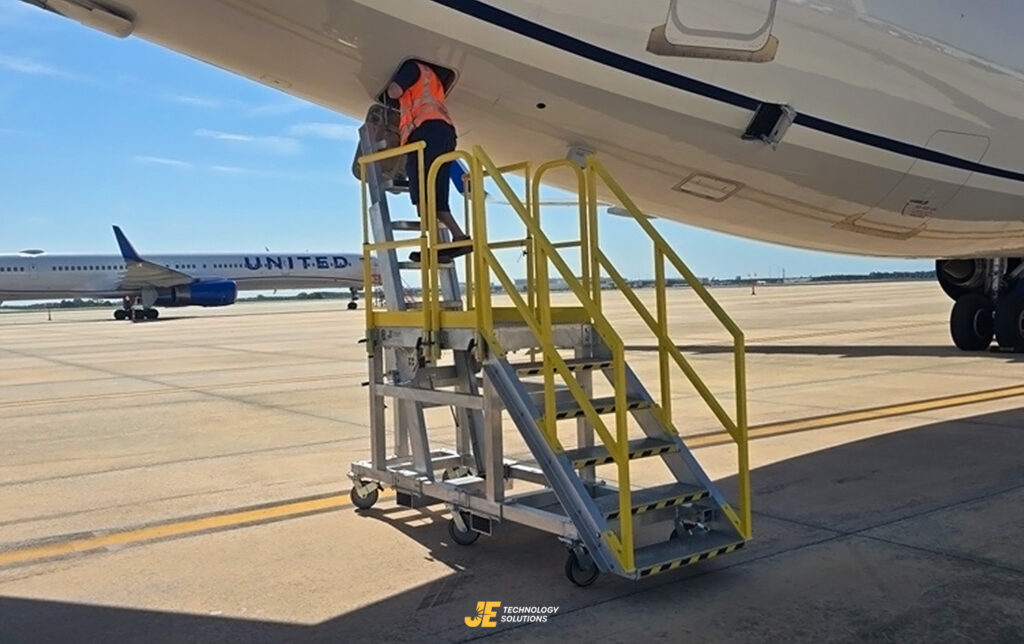
In commercial aircraft maintenance, “hell hole” is an informal term for a confined lower-fuselage equipment or service area. Technicians working in this area may face restricted clearances, difficult entry points, limited room for tools and materials, and aircraft surfaces that must be protected throughout the maintenance task.
The exact location, dimensions, and maintenance requirements vary by aircraft. However, the access challenge typically involves more than reaching a specific height. The technician must be able to approach the opening, enter the work area, position tools or components, perform the task, and exit without the access equipment unnecessarily obstructing the workflow.
Maintenance activity in these areas may include:
Aircraft inspections
Troubleshooting
Equipment-bay servicing
Scheduled maintenance
Component access and replacement
Approved material-handling activities
A suitable platform must therefore account for the aircraft, technician, maintenance procedure, hangar environment, and equipment being moved into or out of the work area.
Makeshift access may require technicians to combine ladders, work platforms, or locally available equipment that was not designed around the aircraft opening. This can increase setup and repositioning, produce inconsistent working conditions, restrict tool movement, and create avoidable contact points near valuable aircraft surfaces.
A solution may allow a technician to reach the general area without supporting the complete maintenance workflow. The team may still need to adjust the equipment repeatedly, work around obstructions, or find a separate method for moving tools and materials. This affects several parts of the operation.
When access equipment must be assembled or combined for each maintenance event, productive work may not begin until the team has identified, transported, positioned, and stabilized each component.
If the initial configuration does not align with the aircraft opening, technicians may have to interrupt the task and reposition the equipment.
A platform must provide more than standing room. Technicians also need a practical path for moving tools, materials, and approved components into and out of the work area.
Feedback shared through JE’s sales process has emphasized the value of maintaining access to the aircraft opening while improving the movement of tools and materials. Any public customer attribution or quotation should be used only after receiving written approval.
The relationship between the ladder, platform, aircraft opening, and technician determines whether the setup supports the maintenance task.
Poor alignment can contribute to unnecessary reaching, awkward positioning, or repeated movement between the platform and surrounding equipment.
Platforms used near an aircraft must account for potential contact points. Equipment that is not designed for aircraft proximity may introduce exposed edges or surfaces that require additional protection.
A lower-fuselage maintenance stand should support controlled positioning, technician access, aircraft protection, tool and material movement, and repeatable use. The appropriate solution must be evaluated as a complete system rather than as an isolated platform, ladder, guardrail, caster, or material-handling feature.
Six inputs should guide the evaluation.
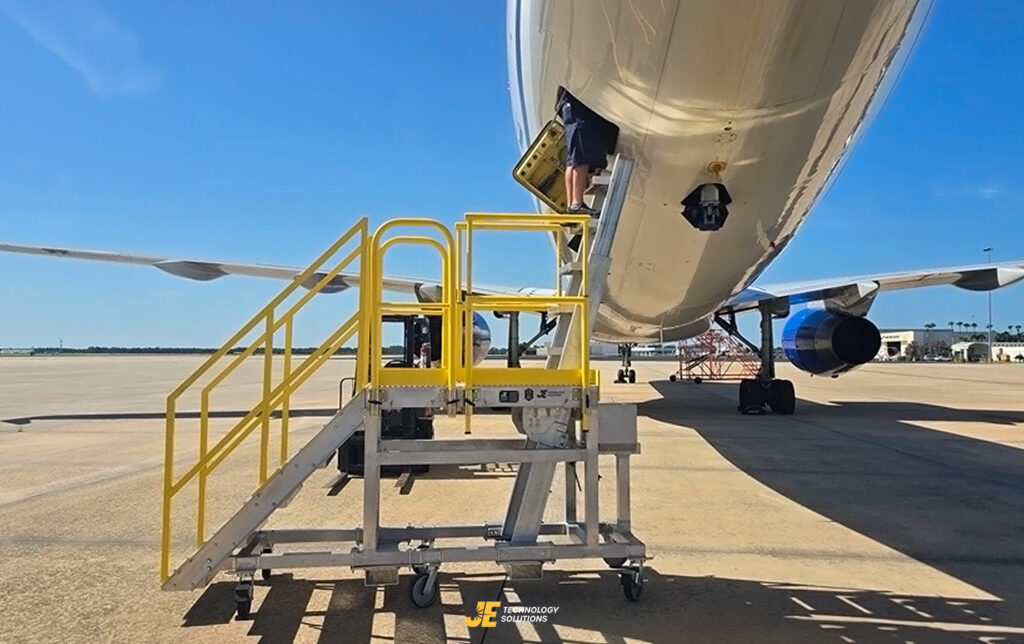
The aircraft model, fuselage contour, access opening, surrounding components, and available clearances determine where the platform can be positioned.
Compatibility with an aircraft family does not eliminate the need to confirm the specific aircraft configuration and maintenance procedure.
The review should consider the working surface, access path, guardrail system, platform stability, anti-skid surfaces, aircraft proximity, and pre-use inspection requirements.
These elements should operate together as part of the intended configuration.
The maintenance opening determines the required platform location, working height, ladder position, and extension placement.
The stand should help the technician approach the work area without creating unnecessary interference around the aircraft.
The evaluation should follow the complete task: entering the platform, reaching the opening, moving tools or materials, performing the work, and exiting the area.
This prevents equipment selection from being based only on a single measurement.
Hangar dimensions, floor conditions, storage space, turning clearances, nearby equipment, and movement paths can affect the stand configuration.
Maintenance planners should also confirm that the equipment can be moved between its storage and operating locations.
The equipment must support the work the team is expected to perform. Inspection access, component replacement, troubleshooting, and material movement can create different positioning and capacity requirements.
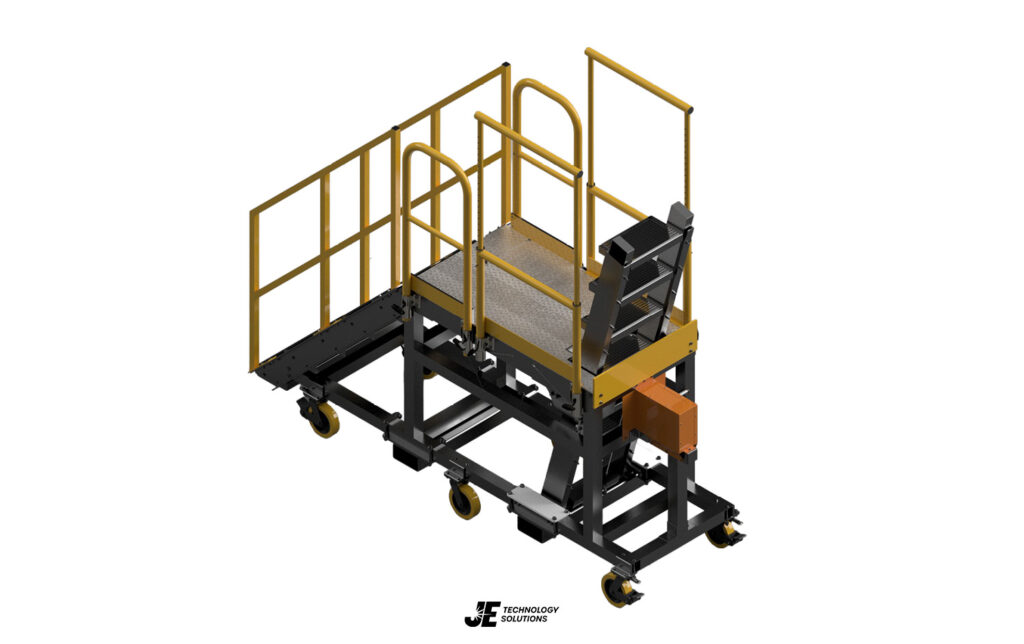
The JE Technology Solutions Hell Hole Maintenance Stand combines an adjustable platform, translating ladder, sliding extensions, guardrails, aircraft protection, mobility, and material-handling capacity. These features create an integrated access system for recurring Boeing 737, Boeing 757, and Airbus A320 lower-fuselage maintenance applications.
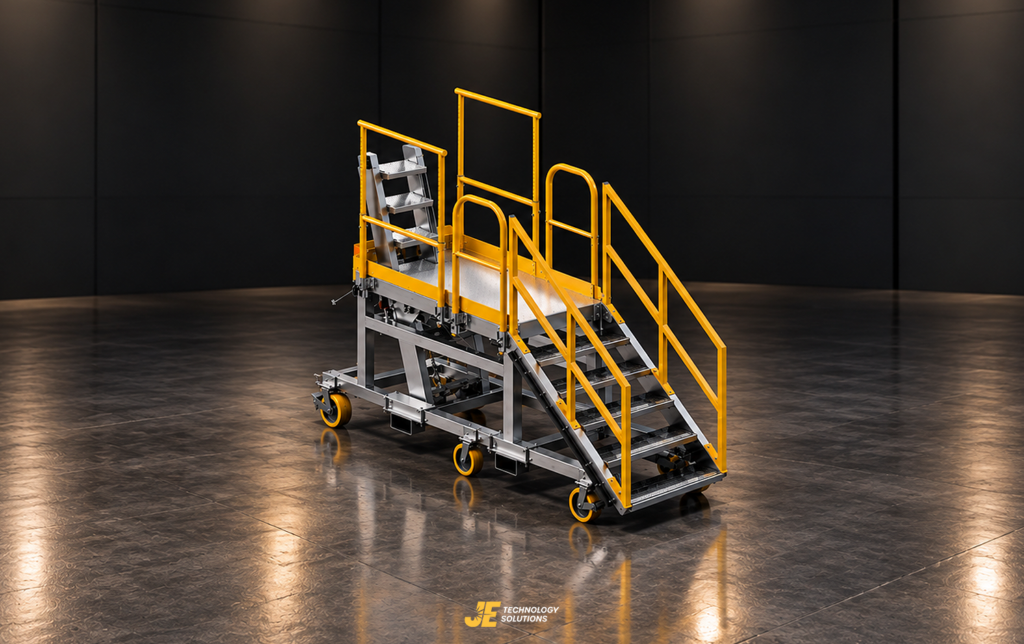
The translating ladder provides controlled access adjustment as part of the overall stand. Integrating the ladder and platform helps create a defined access route for the technician.
The telescoping guardrails provide adjustable edge protection around the elevated work area. The guarding is incorporated into the stand rather than added as a separate temporary system.
Rubber edge protection helps reduce the risk of incidental contact damage around applicable platform interfaces. This is particularly important when access equipment operates near finished aircraft surfaces.
Anti-skid surfaces support secure footing during platform entry, exit, and use. Walking surfaces should be inspected before each use and maintained according to the product documentation.
Eight-inch polyurethane casters support movement through the maintenance facility. Full braking helps secure the stand after it has been properly positioned for the task.
The stand includes a winch rated for up to 1,000 pounds for approved material-handling applications within the equipment’s engineered limits.
Purpose-built access can reduce repeated setup, improve consistency between maintenance events, and support better movement around the aircraft opening. The financial value depends on actual maintenance frequency, technician time, labor rates, and the organization’s current access process. A simple time-based model can help determine whether further evaluation is justified.
Operational value may also include benefits that are not captured by the labor calculation:
More repeatable equipment setup
Improved access to the aircraft opening
Better movement of tools and materials
Reduced dependence on improvised equipment
Greater consistency across technicians or shifts
A defined process for positioning and inspection
Standardization across compatible aircraft applications
The right procurement path depends on how closely Part 30-8635 aligns with the aircraft, task, facility, and technician workflow. JE Technology Solutions can provide the existing engineered product, evaluate changes to that design, or develop a custom solution when the standard configuration does not meet the requirement.
The standard product may be appropriate when its dimensions, capacities, access features, and aircraft interfaces align with the intended maintenance application.
Using an existing engineered solution can simplify technical review, quotation, and procurement when the application is already a strong fit.
A modified configuration may be appropriate when the existing platform provides the right foundation but requires dimensional, mobility, guarding, access, or interface changes.
JE can review the requested adjustments and determine whether the changes can be incorporated into the existing design.
A custom solution may be required when aircraft geometry, facility constraints, maintenance objectives, or technician workflow fall outside the standard product’s capabilities.
The process begins with a requirements review covering geometry, loads, positioning, guarding, aircraft protection, facility conditions, and the intended task.
Q01
The Hell Hole Maintenance Stand supports Boeing 737, Boeing 757, and Airbus A320 lower-fuselage maintenance applications. Final suitability should be confirmed for the aircraft configuration, maintenance procedure, required clearance, and facility.
Q02
The platform has a 600-pound load capacity and a maximum occupancy of one person. The integrated winch has a separate 1,000-pound capacity for approved material-handling applications. These ratings must not be combined or treated as interchangeable.
Q03
Part 30-8635 may provide a more consistent alternative when its dimensions, capacities, and features align with the maintenance requirement. JE should review the aircraft, task, current access method, facility, and anticipated loads before recommending a solution.
Q04
JE can evaluate modifications involving platform dimensions, working height, mobility, guarding, access features, aircraft interfaces, and facility-specific requirements. The engineering team will determine whether modifying the existing product or developing a new solution is the appropriate path.
JE Technology Solutions can help determine whether the standard product, a modified configuration, or a custom-engineered solution best fits your aircraft, facility, and maintenance workflow.
Part 30-8635 for Your Maintenance Operation
