Nose / Forward Platform
Radome, avionics bay, nose landing gear and forward fuselage — the zone JE's earliest F-16 work addressed.
Apopka, Florida // Engineering & Manufacturing // Est. 2004

Contact For Pricing
Nose-mounted avionics, wing-mounted control surfaces and pylons, fuselage systems and tail-section components each demand a different platform geometry — which is why the F-16 line evolved into module-specific platforms rather than one general-purpose stand.
Don’t see the exact fit? We build custom solutions around your exact requirements.
Radome, avionics bay, nose landing gear and forward fuselage — the zone JE's earliest F-16 work addressed.
Fuselage crown, avionics bays and fuselage-mounted systems, at the height the task is performed.
Wing surfaces, leading and trailing edge control surfaces, pylon and fuel system access.
Vertical stabilizer, rudder and tail-mounted components, full height.
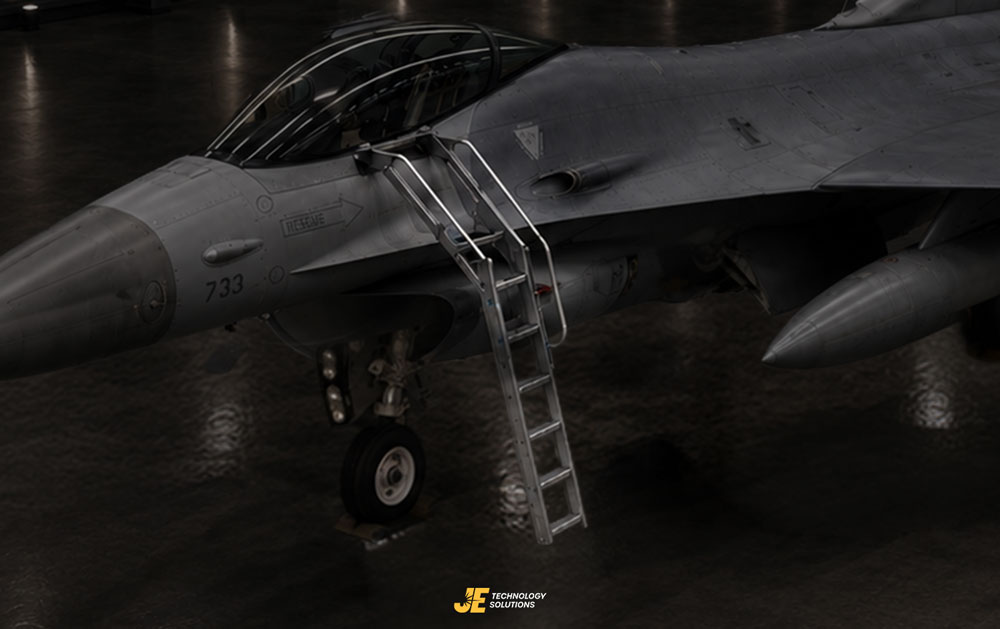
Crew and technician entry to the cockpit — the configuration JE's F-16 programme started from.
Complete airframe coverage in one integrated system, for depot-level programmes handling nose to tail.
JE’s F-16 work began with boarding ladders early in the company’s history, grew into installations at Lackland Air Force Base and AMARG, then international work in Germany and with the Chilean Air Force — a decade-plus track record, not a single contract.
The F-16 programme began with a narrow, specific need: safe crew and technician entry to the aircraft.
Domestic installations expanded across USAF maintenance depots with flight-line proven hardware.
Work in Germany and for the Chilean Air Force proved our equipment on global allied airbases.
Six configurations: five module-specific platforms plus a turnkey Full Wrap maintenance stand.
Equipment engineered and re-engineered across a real range of installations — hangar layouts, maintenance procedures and even climate vary base to base and country to country, and equipment that ignores that variability creates exactly the adjustability and safety gaps JE’s F-16 customers asked to have solved.
Crowded flight lines and expensive airframe surfaces show up at every base JE has delivered to — so both are engineered into every platform in the line rather than treated as options.
Crowded flight lines
Ramps and hangars are crowded by design, which is why every JE F-16 platform uses a lightweight, compact aluminum frame sized for tight flight-line spacing rather than a bulkier general-purpose stand.
Expensive airframe surfaces
The F-16's composite and coated surfaces are costly to repair and easy to damage with the wrong contact point — so every platform uses non-marring, contoured edges engineered around the aircraft's actual surface geometry, not a flat generic edge that happens to be padded.
Two of JE’s F-16 programmes have their own project records — one deployed overseas from a USAF-refined design, one fitted to a different air force’s unequal floor space.
Equipment engineered and re-engineered across a real range of installations — hangar layouts, maintenance procedures and even climate vary base to base and country to country, and equipment that ignores that variability creates exactly the adjustability and safety gaps JE’s F-16 customers asked to have solved.
Share public-safe project details so the right JE specialist can review your application, requirements, and target timeline.
"*" indicates required fields