Apopka, Florida // Engineering & Manufacturing // Est. 2004

Product overview

A boarding ladder is the one access product that must rest against a fighter’s fuselage, at the canopy sill, in the dark, in a hurry — and leave no mark.

F-16 Boarding Ladder | JE Technology Solutions

$0.00 USD

Contact For Pricing

Application
Aerospace
Product type
Stepladders and boarding stairs
F-16
F-16
Commercial model
Quote-led
01 Four contact risks

Every Boarding Ladder Touches the Aircraft Four Times

Zero-contact is the principle on every other JE platform. A boarding ladder cannot honour it — the ladder has to rest on the jet. So each contact point is engineered deliberately rather than left to happen.

Contact point // what can go wrong // how it is engineered 4 POINTS
Contact point What can go wrong How it is engineered
C1 Canopy sill
The one place the ladder must bear on the airframe. Bare metal marks the sill lip.
Non-marking bearing pads shaped to the sill profile, so the load spreads instead of concentrating.
C2 Fuselage side
A ladder rested at the wrong angle rubs the skin every time weight shifts.
Standoff geometry that fixes the resting angle, so the frame cannot swing into the fuselage.
C3 Ground at the base
A foot that slides moves the top of the ladder across the paint.
Footing specified for apron surface, so movement at the base does not become movement at the sill.
C4 Handling into position
Most damage happens while the ladder is being carried and placed, not while it is in use.
Weight and grip points set for one-person handling, with the contact faces the only thing that can reach the jet.
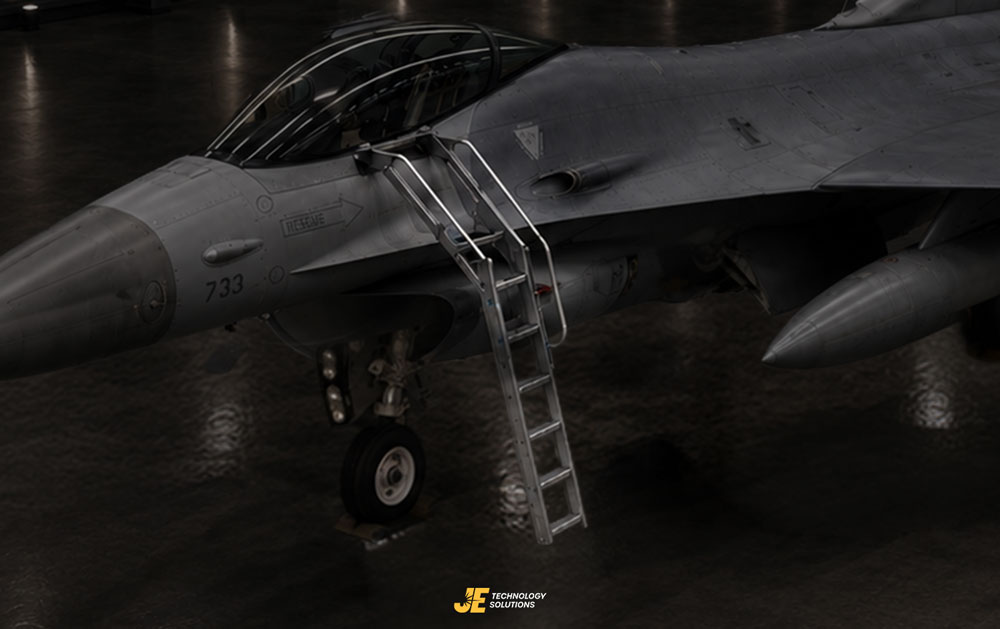
Only one of the 4 contact points is unavoidable — the sill. The other three are consequences of how the ladder is placed and handled, which means they are engineering decisions rather than facts of life.
Why this product is airframe-specific

A boarding ladder is fitted to a canopy sill, not to a height.

The sill position, the fuselage curve beneath it, and the clearance to the intake all belong to one airframe. That is why this is an F-16 product rather than an adjustable one — and why a general-purpose stepladder at the same height is not the same thing.

02 Standard features

Built Around Safe, Repeatable Access

Final features and configuration follow the approved operational requirement and product scope.

F1 Design

Application-led geometry

The handling envelope is evaluated around the door, the gear bay, technicians, and workflow.

F2 Design

Integrated safety

Restraint, stability, and controlled movement are considered as part of the complete fixture.

F3 Build

Manufacturing quality

Fabrication, assembly, inspection, and documentation support the approved project requirements.

F4 Design

Operational efficiency

Layouts are developed to support positioning, movement, and repeatable removal and refit.

F5 Engineering

Custom configuration

Existing designs may be adapted where operational requirements call for a different solution.

F6 Support

Long-term support

Documentation and continued support are included as applicable to the project scope.

Custom engineering available

JE supports engineering solutions for operational challenges that are not fully addressed by a standard configuration. The team can evaluate geometry, workflow, safety, integration, and manufacturing requirements before recommending the best-fit path.

03 Product documentation

Two Documents, Requested Not Downloaded

Public articles remain open. Product one-pagers and technical documents use a request flow rather than a direct download, so the specialist who answers already knows the airframe and the base.

D1

By request

Product Overview

Public-safe overview and product context, sent after a short requirements exchange.

D2

By request

Consultation Checklist

What to prepare before a requirements call — including door, frequency and crew size.

Discuss the F-16 Boarding Ladder

Tell us the block, the base, and how many aircraft the ladder has to serve.

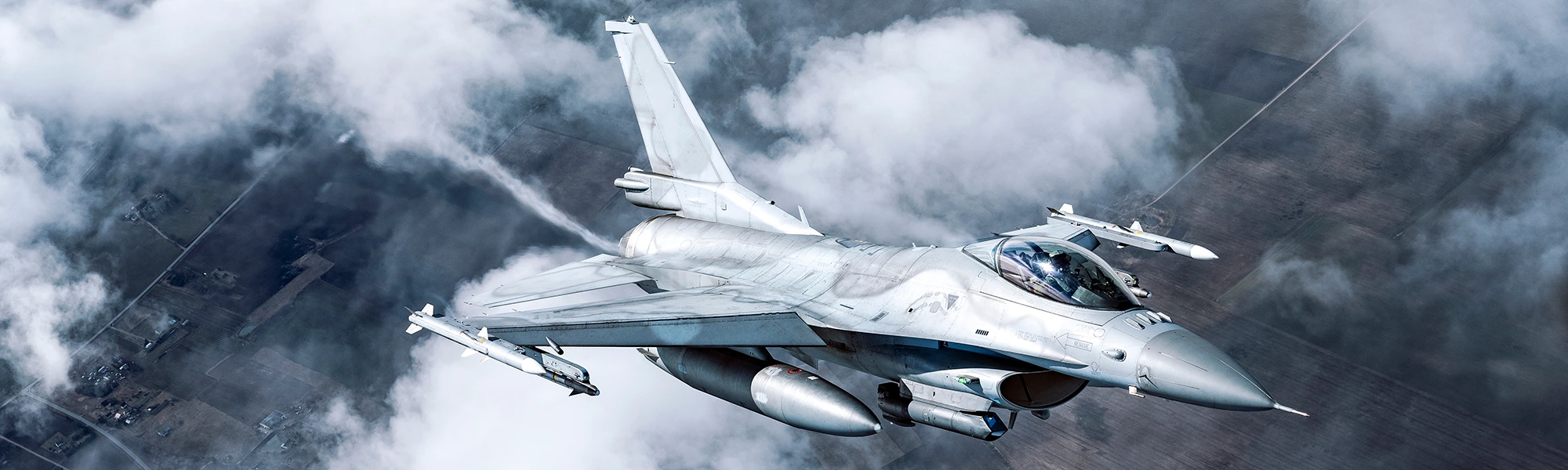
An F-16 on the flightline
Flightline Three air forces, one proven platform.
Request a Quote
Product and Resources

Related Products

Bring the access, maintenance, or manufacturing challenge to the JE team — and ask for whatever documentation your process needs alongside it.

Crossover Ladders | JE Technology Solutions

View Product

F-16 Aircraft Maintenance Stands | JE Technology Solutions

View Product

JE Resources

Documented programmes are the strongest form of assurance JE can publish without a certificate attached — three of them, in full, with the customer and location named.
Technical & operational FAQ

Questions About the P-8 Poseidon

Q01

Can JE adapt an existing solution for the F-16 boarding ladder?

Yes. The project begins by validating geometry, operational needs, safety requirements, workflow, and the scope of the requested adaptation.

Q02

Can JE support engineering-only or manufacturing-only engagements?

JE can participate at different project stages, including engineering, machining, manufacturing, assembly, or complete end-to-end delivery.

Q03

How are quality and documentation handled?

The project lifecycle includes assembly and quality verification followed by supporting drawings, manuals, quality records, and continued support as applicable to the approved scope.

Connect with a solution specialist

Let's Turn Your Requirements Into a Solution

Share public-safe project details so the right JE specialist can review your application, requirements, and target timeline.

"*" indicates required fields

Do not submit controlled data. Do not include drawings, export-restricted information, ITAR-sensitive technical data, or Controlled Unclassified Information (CUI) in this public website form.