Apopka, Florida // Engineering & Manufacturing // Est. 2004
Apopka, Florida // Engineering & Manufacturing // Est. 2004
C-130 maintenance fall protection is most effective when access is designed around the complete maintenance workflow—not just one work point.
Effective C-130 maintenance fall protection combines purpose-built work platforms, continuous access between maintenance zones, passive fall protection such as guardrails, and task-specific fall-arrest solutions where required.
The goal is to keep technicians on a stable, dedicated work surface as maintenance moves around the aircraft.
Technicians may need to reach the wing, engines, propellers, fuselage, nose, tail, landing gear, and cargo-ramp zones during the same maintenance event. A coordinated access system helps crews move safely and efficiently between those zones while keeping tools, utilities, and fall-prevention measures close to the work.
C-130 maintenance requires access across a large, complex airframe.
Separate ladders and stands can interrupt workflow when crews must descend, reposition equipment, and climb back up.
Guardrails, controlled transitions, and stable work platforms help prevent falls before personal fall-arrest equipment is needed.
JE Technology Solutions engineers C-130 access systems around aircraft geometry, maintenance tasks, facility conditions, and workflow requirements.
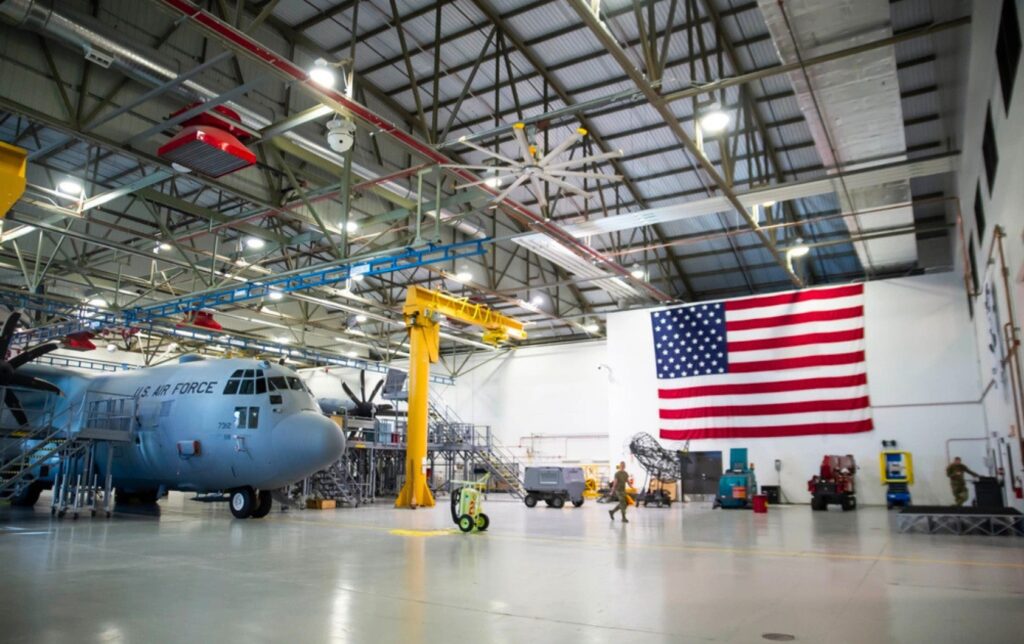
The C-130 Hercules is not maintained from one location. During ISO inspections and other maintenance events, technicians may need to move between upper-wing surfaces, engines and propellers, the flight deck, fuselage systems, the tail, and cargo-ramp areas.
The challenge is not only reaching each area. It is creating a safe, repeatable, and efficient route between them.
When access relies on disconnected mobile stands, ladders, or isolated platforms, the access process itself can slow the work.
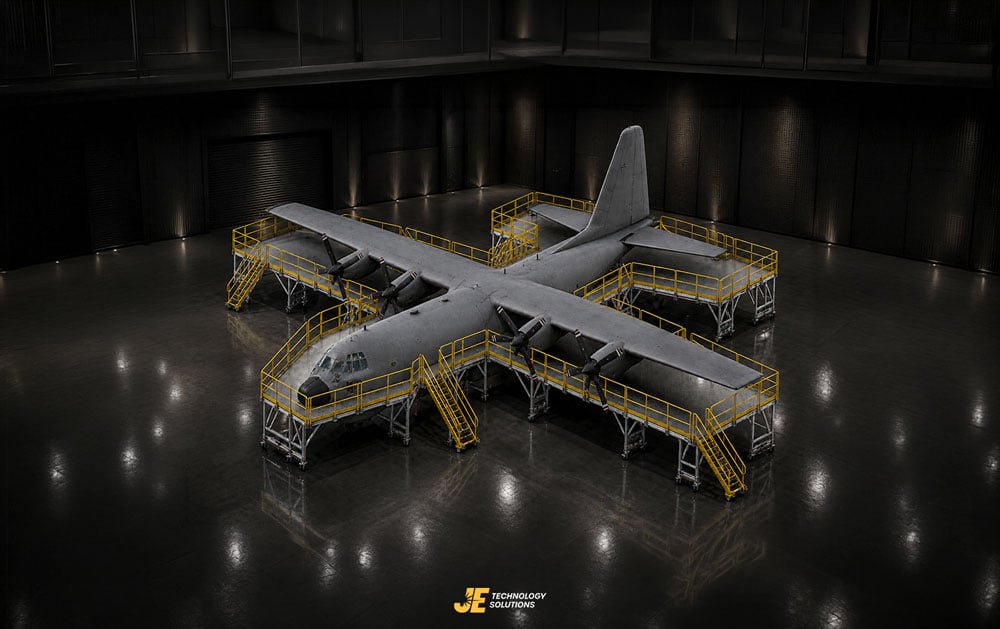
Disconnected access equipment can add unnecessary movement, setup time, and coordination to an already detailed maintenance process.
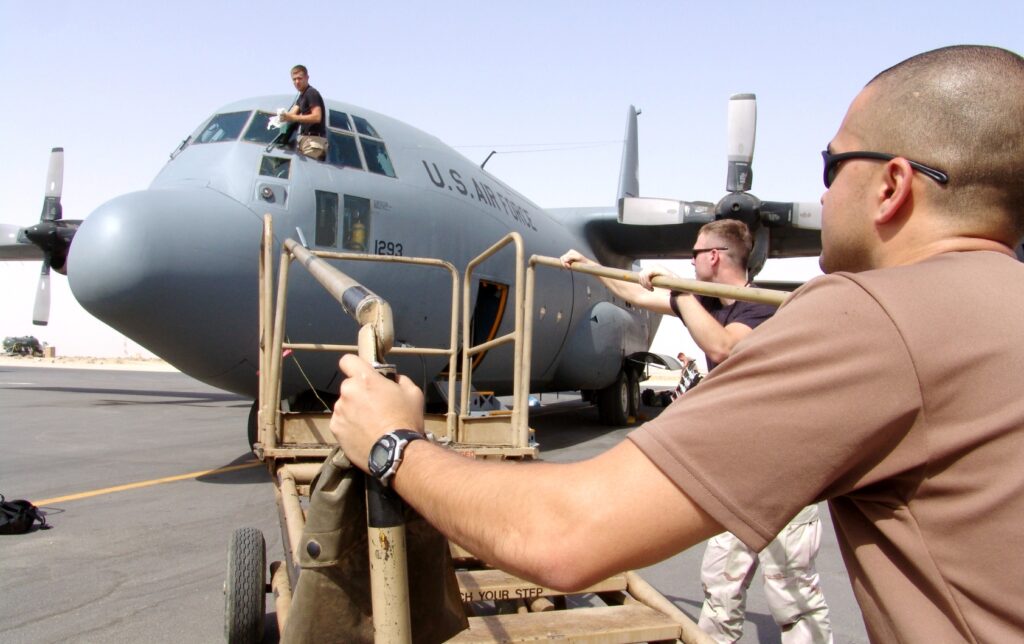
When separate platforms do not connect, technicians must treat each work area as a new setup. Moving between the wing, fuselage, engine, and tail can require crews to descend, reposition equipment, verify clearance, and climb back up.
Across a detailed maintenance event, those transitions can interrupt inspection momentum and add avoidable travel to the workflow.
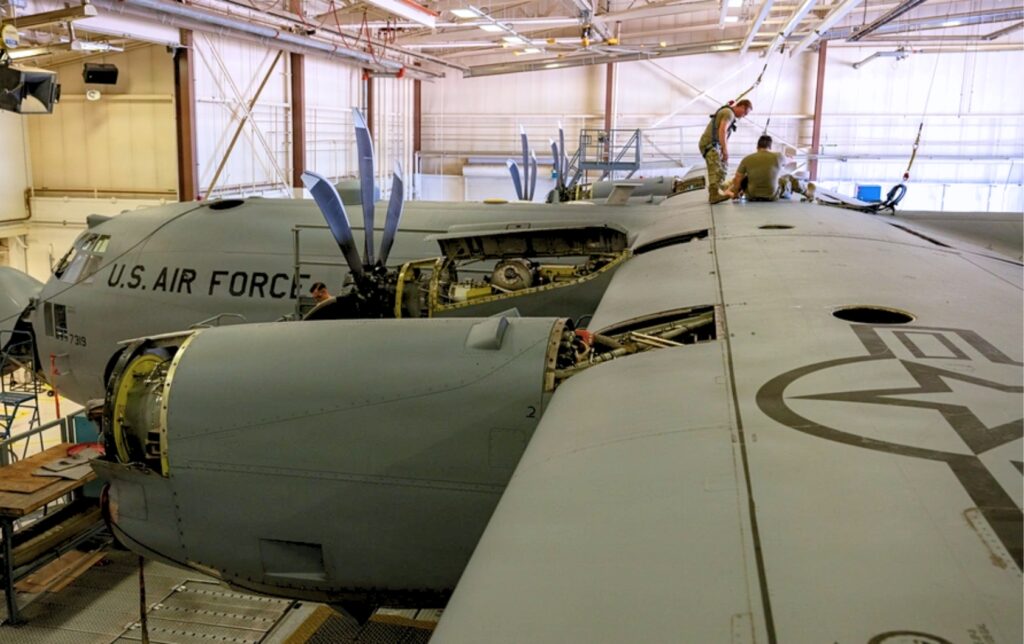
Aircraft surfaces are where technicians perform maintenance—not where access planning should end.
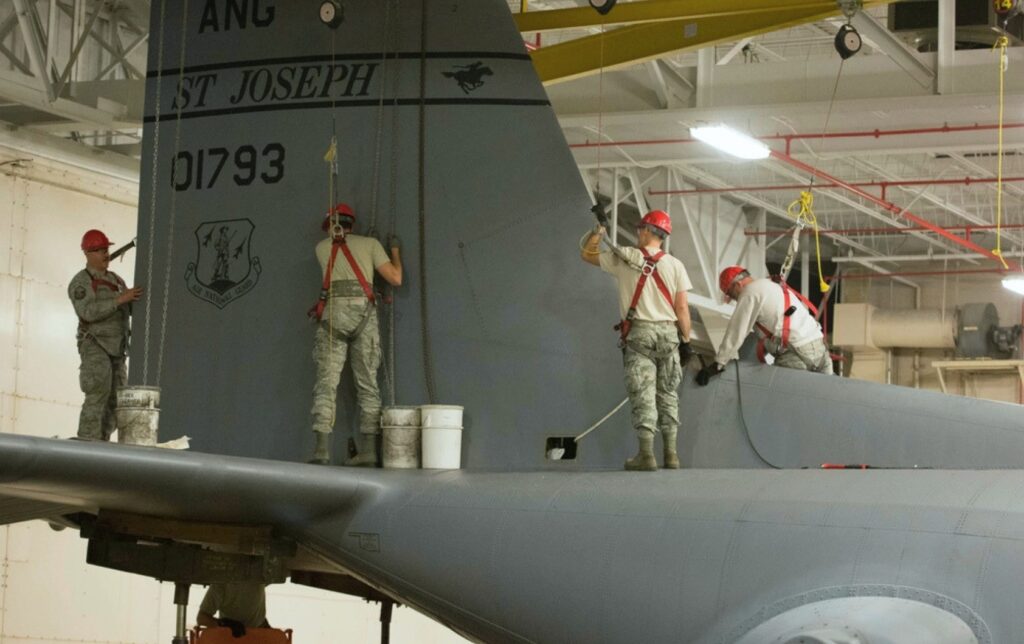
When disconnected platforms force crews onto the airframe to move between nearby work zones, the maintenance path is no longer fully defined by the access system. Integrated wing access and connected platform sections help create a more controlled route around the aircraft.
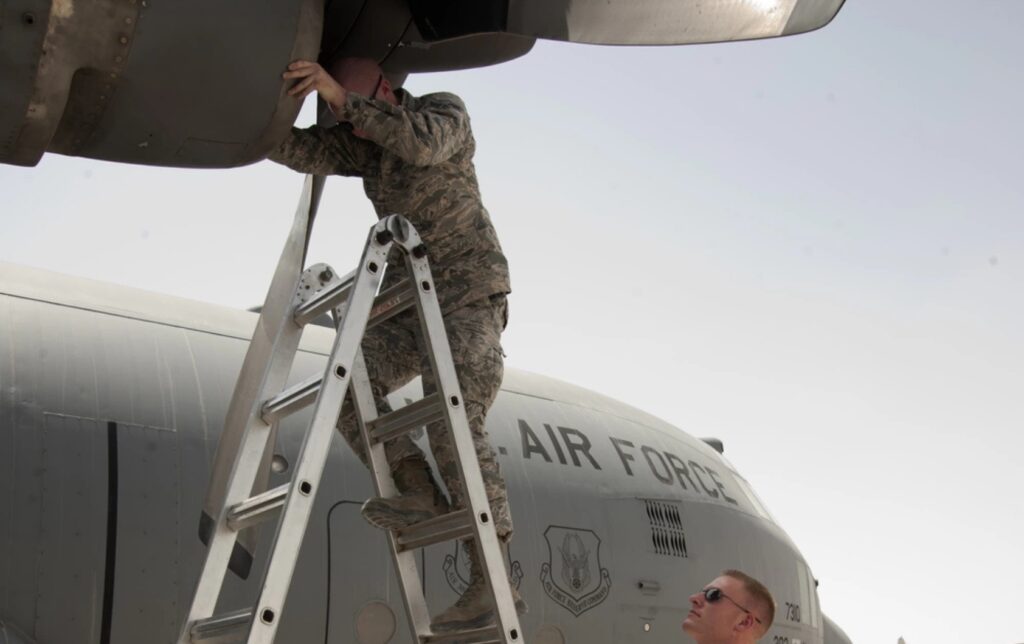
Harnesses and lifelines are essential for many elevated maintenance tasks. But personal fall-arrest equipment alone does not solve every access challenge.
Fall prevention starts with the work environment: stable work surfaces, guardrails, controlled transitions, self-closing gates, and platform geometry designed for the aircraft and task.
When lighting, power, compressed air, tools, and parts remain on the hangar floor, technicians spend more time traveling between the work area and support equipment.
A coordinated access system can help place those resources closer to where maintenance happens, reducing ground clutter and supporting a more organized work environment.
JE Technology Solutions engineers aircraft maintenance access systems around the actual work to be performed.
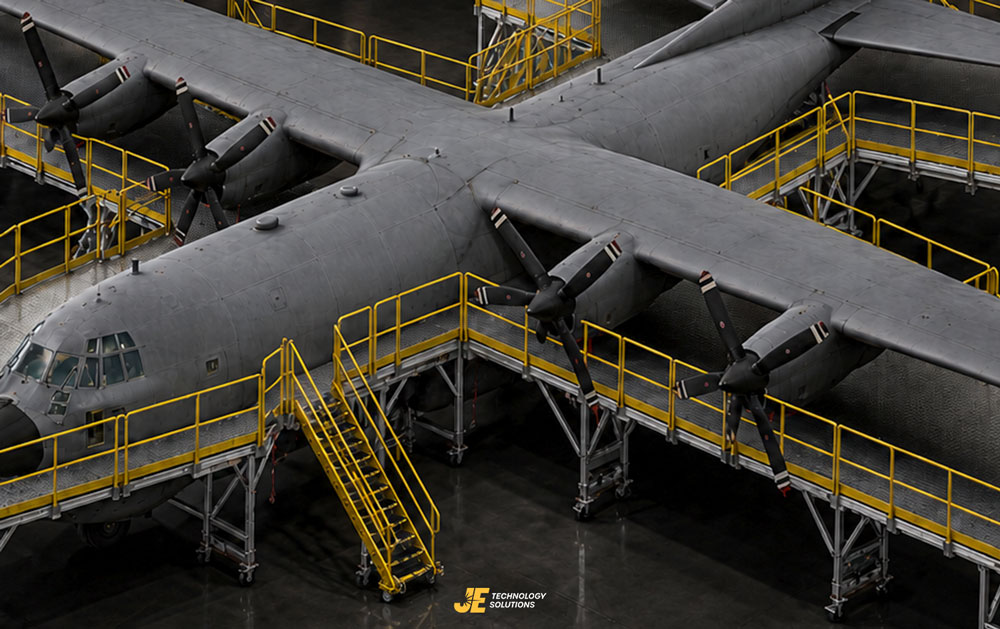
For the C-130 Isochronal Stand System, JE’s full-wrap configuration connects wing, nose, tail, and bridge zones into a coordinated work environment. The goal is to help maintenance teams maintain access as the work moves around the airframe.
Wing maintenance requires more than reaching the aircraft. It requires a stable work surface that supports inspection and maintenance across the wing area while connecting technicians to adjacent work zones.
JE’s integrated wing access helps crews remain on a dedicated platform path rather than relying on disconnected equipment or transitions across the airframe.
C-130 engine and propeller maintenance requires access geometry that accommodates the nacelle, propeller area, and component-removal needs.
Purpose-built access helps technicians reach the task while preserving the clearance and flexibility required for maintenance operations.
The wing is only one part of the access challenge. A complete C-130 maintenance strategy may also require access to:
Nose and forward-fuselage systems
Flight deck and avionics areas
Upper fuselage work zones
Tail, rudder, and stabilizer surfaces
Landing gear and lower-airframe areas
Cargo-ramp and rear-fuselage zones
JE’s modular approach allows access zones to be planned as part of one coordinated system or configured for a specific maintenance need.
Before engineering a C-130 access solution, JE evaluates the requirements that affect how a maintenance team will use the system:
This approach applies beyond the C-130. Any large or complex airframe can benefit from access equipment designed around the maintenance workflow rather than adapted after the fact.
Aircraft variant, contour, clearance points, and access elevations.
Inspection locations, component removal, and technician movement between work zones.
Guardrails, gates, tie-off requirements, controlled transitions, and task-specific fall-arrest considerations.
Hangar layout, floor conditions, overhead clearance, utilities, and aircraft movement.
Lighting, power, compressed air, tool access, material handling, and technician travel paths.
How access supports inspection, repair, towing, and future maintenance needs.
This approach applies beyond the C-130. Any large or complex airframe can benefit from access equipment designed around the maintenance workflow rather than adapted after the fact.
Can technicians reach every planned work zone from a stable platform?
Do access sections connect where crews need to move?
Does the system support fall prevention through guardrails, gates, and defined work paths?
Can the platform height and geometry match the aircraft and maintenance task?
Are power, lighting, air, tools, and parts positioned close to the work?
Will the system preserve access to aircraft doors, landing gear, cargo ramps, and component-removal zones?
Can the system evolve with changing maintenance requirements?
The right procurement path depends on how closely Part 30-8635 aligns with the aircraft, task, facility, and technician workflow. JE Technology Solutions can provide the existing engineered product, evaluate changes to that design, or develop a custom solution when the standard configuration does not meet the requirement.
The standard product may be appropriate when its dimensions, capacities, access features, and aircraft interfaces align with the intended maintenance application.
Using an existing engineered solution can simplify technical review, quotation, and procurement when the application is already a strong fit.
A modified configuration may be appropriate when the existing platform provides the right foundation but requires dimensional, mobility, guarding, access, or interface changes.
JE can review the requested adjustments and determine whether the changes can be incorporated into the existing design.
A custom solution may be required when aircraft geometry, facility constraints, maintenance objectives, or technician workflow fall outside the standard product’s capabilities.
The process begins with a requirements review covering geometry, loads, positioning, guarding, aircraft protection, facility conditions, and the intended task.
Q01
An ISO, or isochronal, inspection is a scheduled, detailed maintenance event that evaluates the aircraft for discrepancies and required repairs to support continued airworthiness.
Q02
Connected platforms help technicians move between work zones without repeatedly descending, relocating separate stands, and climbing back up. This supports a more consistent maintenance workflow.
Q03
Passive fall protection helps prevent a fall without requiring the worker to actively connect to equipment at every moment. Guardrails, gates, covers, and engineered work stands are common examples.
Q04
Yes. Aircraft maintenance platforms can be engineered around a specific airframe, task sequence, facility layout, utility requirements, height range, and fall-protection needs.
Q05
No. JE Technology Solutions designs aircraft access, fall-protection, ground-support, and custom fabrication solutions for commercial and military aerospace operations.
Talk to JE Technology Solutions about your C-130 access challenge or aircraft maintenance platform requirements.
Part 80-0018 for Your Maintenance Operation

To provide the best experiences, we use technologies like cookies to store and/or access device information. Consenting to these technologies will allow us to process data such as browsing behavior or unique IDs on this site. Not consenting or withdrawing consent, may adversely affect certain features and functions. Learn More at JETechnologySolutions.com/privacy-policy