Apopka, Florida // Engineering & Manufacturing // Est. 2004
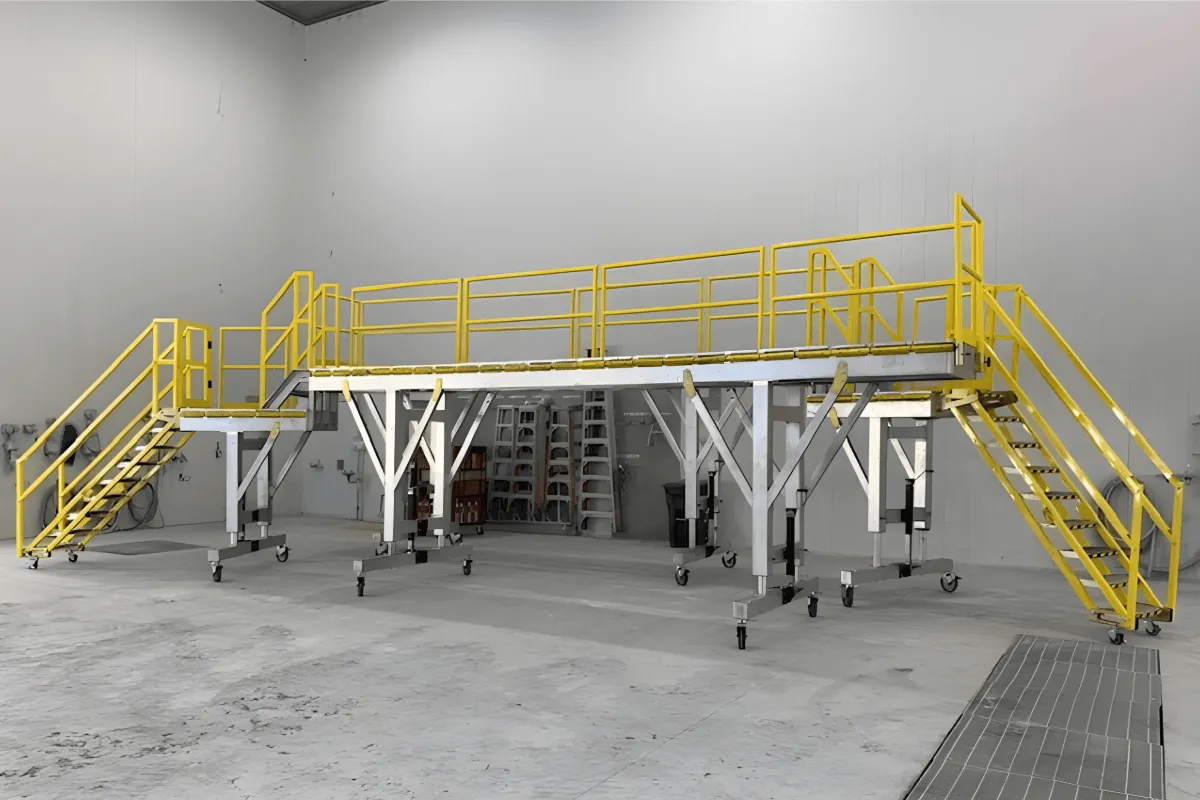
An aircraft fixture is used a few times a year by the same specialists. An industrial work stand is used every shift by a rotating crew — and that single difference changes what has to be engineered into it.
Same platform, different requirement. The duty cycle is what separates them.
A stand used twice a year by a trained crew and a stand used every shift by whoever is rostered are not the same product. Each factor below is a place where high duty cycle changes the requirement — and each has a different consequence when it is missed.
The stand is repositioned, climbed and loaded many times a day rather than a handful of times a year.
The person using it this shift may not be the person who used it last shift.
Height or position changes between jobs, sometimes several times a shift.
Production floors put coolant, chips and dust on every surface every day.
No single team owns the stand, so nobody inspects it by default.
All 5 factors come from the same two facts — it is used often, and not always by the same person. Neither appears on a drawing, which is why they are worth stating before one is made.
On a specialist fixture that question rarely arises — the same three people use it. On a production floor with shift rotation and new starters, a stand that depends on being used correctly will eventually be used incorrectly. The answer is geometry that makes the wrong action difficult, not a label that asks for the right one.
A requirements conversation for a production-floor stand starts with the work pattern, not the dimensions.
How many times a day, by how many different people, and whether it moves between stations.
Decides
Procedure and heat input control
The machine, cell or line the stand works to, and where the operator has to reach.
Decides
Deck height and footprint
Coolant, swarf, wash-down, and whether the floor is level where it stands.
Decides
Finish, drainage and castors
Trained cell operators, a rotating crew, or contractors who may never have seen it.
Decides
How much the geometry has to enforce
Production-floor access is a family, not a single product — and the same duty-cycle reasoning runs through all of it.
JE’s platform family for manufacturing and processing facilities.
Platforms, stair towers and crossovers as one connected access path.
Access engineered around machinery where failure is not an option.
A facility-specific access system built around one plant’s equipment footprint.
Duty cycle and familiarity. An aircraft fixture is used occasionally by the same trained specialists; a production stand is used every shift by whoever is rostered. That changes wear specification, adjustment method, and how much the geometry itself has to prevent misuse.
Where the work pattern calls for frequent adjustment, yes — because a stand that needs a tool to adjust will be left at the wrong height instead.
Configured per requirement. The work pattern, the equipment served, the floor conditions and who uses it set the specification, rather than a stand being selected from fixed options.
How many times a day is it used, by how many different people, and does it get moved? Those three answers size the stand.