Apopka, Florida // Engineering & Manufacturing // Est. 2004

Product overview

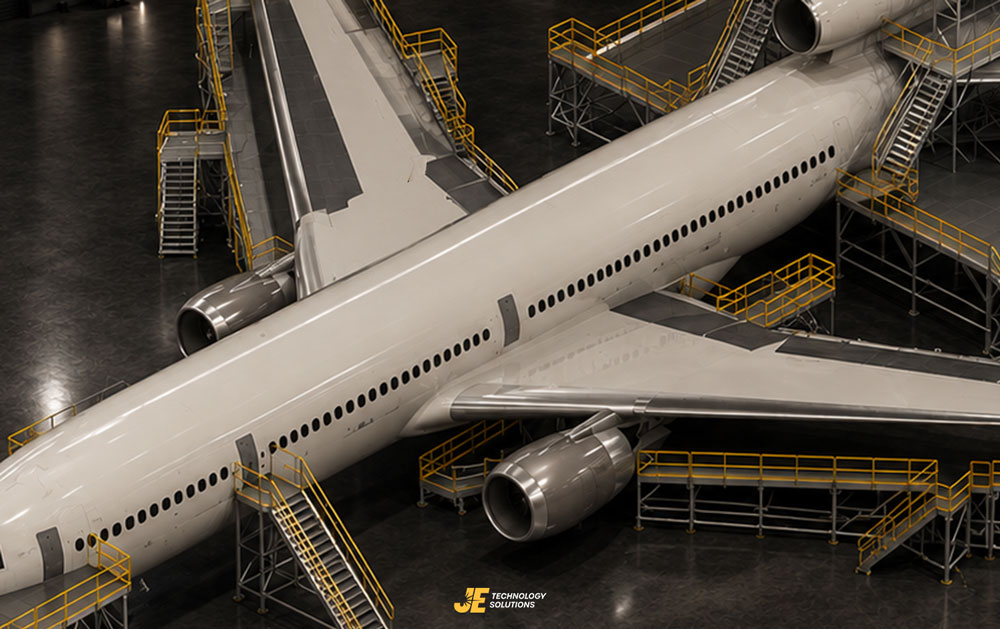
The DC-10 Full Wrap Maintenance Stand is a complete, custom-engineered aircraft maintenance stand system for the DC-10 (three-engine wide-body airliner). Combining every structural access module — nose, wing, tail, fuselage, and boarding access — into one integrated platform, it delivers OSHA-compliant, 360-degree access around the airframe for MRO, depot-level maintenance, and flight-line operations.

DC-10 Full Wrap Maintenance Stand

00

Contact For Pricing

Application
Industrial, aerospace, facility
Product type
Fixed platform access
Permanent
Permanent
Commercial model
Quote-led
01 Three angle bands

Floor Space Decides the Angle. The Angle Decides the Type.

Rise is fixed by the platform. Going is whatever floor space you can give it. Those two together set the angle — and the angle determines which type of permanent access you are allowed to build, and how it can be used.
Angle band Type How it can be used3 Bands
Angle from floorTypeWhat it allows
A130–38°widest going
Stairway
Normal walking gait, hands free to carry tools or parts, and comfortable to use repeatedly through a shift.
A250–70°reduced going
Ship ladder / stepped ladder
Climbed facing forward with one hand on the rail — usable, but not while carrying.
A375–90°least going
Fixed ladder
Both hands on the rungs, climbed facing the structure. Anything carried has to be hoisted separately.
Hands free to carryOne hand or both needed on the rail

Only the shallowest of the 3 bands leaves both hands free. That is why floor space at the base is a safety question and not just a layout one — giving the flight less going forces a steeper type, and a steeper type changes what the crew can carry up.

The question to answer first

How much floor can you give it? Everything else follows from that number.

A shallow flight needs more going than a steep one for the same rise. If the floor space is not there, the answer is not a steeper stair — it is a change of type, a switchback with a landing, or a different route to the platform altogether. That decision belongs at the start, not after fabrication.
02 Standard features

Built Around Safe, Repeatable Access

Final features and configuration follow the approved operational requirement and product scope.
F1 Design

Application-led geometry

The access envelope is evaluated around equipment, aircraft, technicians, and workflow.

F2 Design

Integrated safety

Guarding, access, stability, and working surfaces are considered as part of the complete system.

F3 Build

Manufacturing quality

Fabrication, assembly, inspection, and documentation support the approved project requirements.

F4 Design

Operational efficiency

Layouts are developed to support positioning, movement, and repeatable maintenance tasks.

F5 Engineering

Custom configuration

Existing designs may be adapted where operational requirements call for a different solution.

F6 Support

Long-term support

Documentation and continued support are included as applicable to the project scope.

What the requirements review examines
JE supports engineering solutions for operational challenges that are not fully addressed by a standard configuration. The team can evaluate geometry, workflow, safety, integration, and manufacturing requirements before recommending the best-fit path.
03 Product documentation

Two Documents, Requested Not Downloaded

Public articles remain open. Product one-pagers and technical documents use a request flow rather than a direct download, so the specialist who answers already knows the application.

D1

By request

Product Overview

Public-safe overview and product context, sent after a short requirements exchange.

D2

By request

Consultation Checklist

What to prepare before a requirements call — including the rise and available floor space.

Discuss a Fixed Platform Stairway

Send the rise to the platform and the floor space available at the base. Those two numbers decide most of it.
Fixed access Rated, inspected, and set to the task.
Request a Quote
Product and Resources

Related Products

Bring the access, maintenance, or manufacturing challenge to the JE team — and ask for whatever documentation your process needs alongside it.

Helicopter Maintenance Stands

View Product

F-35 Aircraft Maintenance Stands | JE Technology Solutions

View Product

F-16 Aircraft Maintenance Stands | JE Technology Solutions

View Product

JE Resources

Documented programmes are the strongest form of assurance JE can publish without a certificate attached — three of them, in full, with the customer and location named.
Technical & operational FAQ

Questions About the P-8 Poseidon

Q01

Can JE adapt an existing solution for a fixed platform stairway?

Yes. The project begins by validating geometry, operational needs, safety requirements, workflow, and the scope of the requested adaptation.

Q02

Can JE support engineering-only or manufacturing-only engagements?

JE can participate at different project stages, including engineering, machining, manufacturing, assembly, or complete end-to-end delivery.

Q03

How are quality and documentation handled?

The project lifecycle includes assembly and quality verification followed by supporting drawings, manuals, quality records, and continued support as applicable to the approved scope.

Connect with a solution specialist

Let's Turn Your Requirements Into a Solution

Share public-safe project details so the right JE specialist can review your application, requirements, and target timeline.

"*" indicates required fields

Do not submit controlled data. Do not include drawings, export-restricted information, ITAR-sensitive technical data, or Controlled Unclassified Information (CUI) in this public website form.