Apopka, Florida // Engineering & Manufacturing // Est. 2004
Everywhere else on this floor the constraint is geometry. In wet paint it is the environment — dust, humidity, temperature and time. Four stages, each with something that ruins it and something that keeps it out.
The cure window governs 2 of the 4 stages — Assembly and Quality Verification.
Almost every paint defect is traceable to something that was present before the gun was picked up, or to a clock that was not respected afterwards. Each stage has one thing that ruins it, and one thing that keeps that out.
Blast, clean and profile the substrate so the coating has something to hold on to.
Spray application to the specified film thickness and colour.
Joining the finished parts into the delivered unit.
Confirming film thickness, adhesion, coverage and appearance.
All 4 contaminants are excluded before or during the stage they threaten, never afterwards. A coating defect found at inspection is a strip and recoat, not a touch-up.
Which is why the cure window governs both assembly and final inspection on this page. Handling a part early puts marks on a finish that has already passed the booth, and inspecting early passes a film that has not finished hardening.
Wet paint is chosen when colour matching, touch-up in the field, or a coating specification calls for it. The other six are available on the same floor, and the right one follows from where the part lives.
Wet paint — colour match and field touch-up.
Harder film, no field touch-up.
Outdoor and corrosive service.
Appearance-critical stainless.
Directional finish, low glare.
Uniform matte, good key.
Deburred, uncoated.
Paint is applied at the end of stage three and has to survive stages four and five. Each stage produces something specific, and the approved scope decides which of them JE runs.
Understanding the application, environment, and operational need before anything is drawn.
Produces: An agreed scope
Developing a manufacturable solution around that scope.
Produces: Drawings and analysis
Fabrication and finishing — surface preparation and wet paint sit at the end of this stage.
Produces: Finished, coated components
Joining and inspecting, both governed by the cure window above.
Produces: A verified assembly
Packaging and transport, protecting the finish in transit.
Manuals, coating records and continued assistance after handover.
Produces: Records and support
Two programmes where the paint environment set the engineering, and one where the finish had to survive a part being handled repeatedly.

Paint booth access
Access engineered for a booth where the finishing environment set the constraints on everything inside it.

Painting access
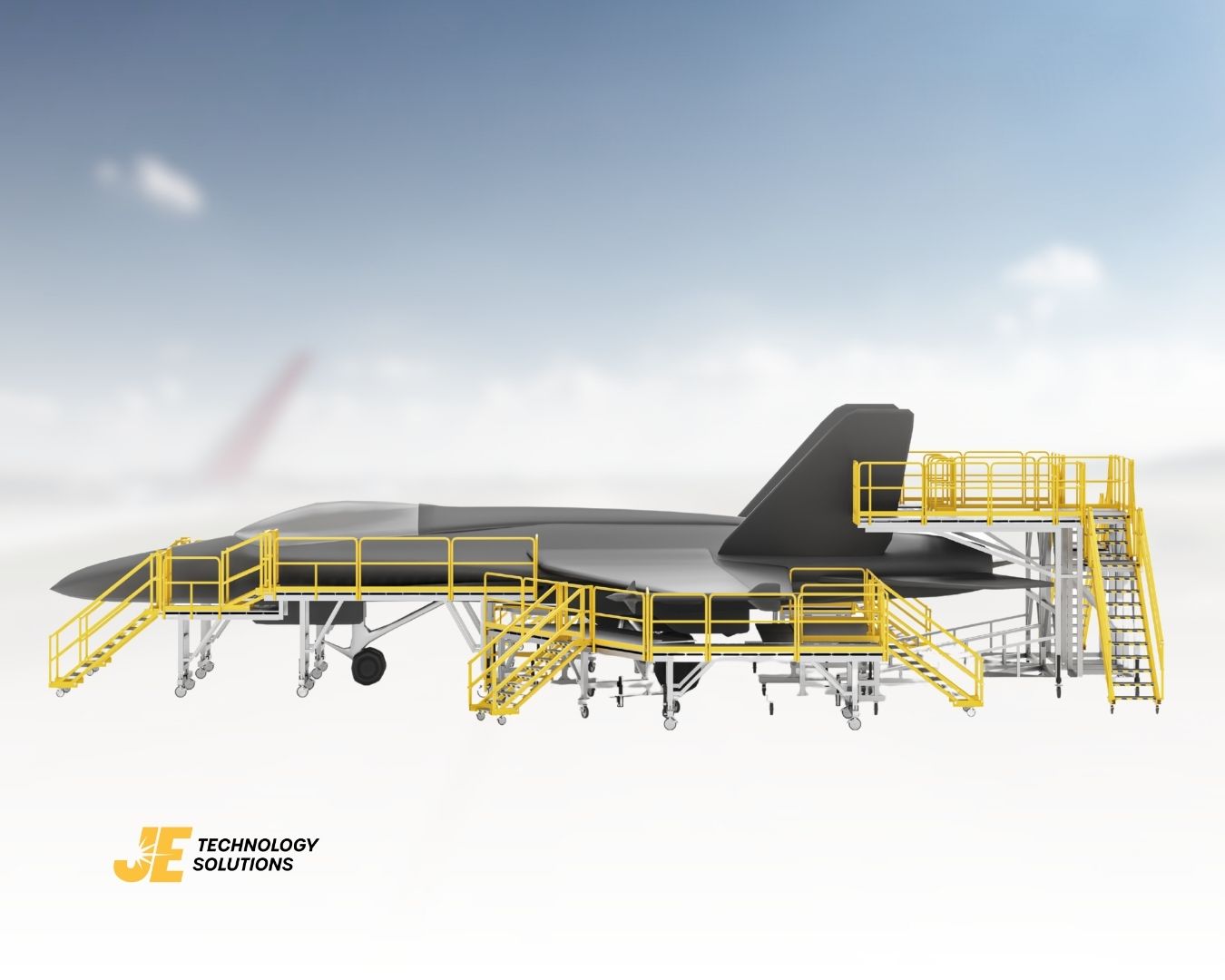
Purpose-built aluminium stands replacing worn steel, drawn to the aircraft actually being painted.

Handled repeatedly
A fixture whose finish has to survive being handled every time it carries a flight-critical part.
Wet paint is chosen where colour matching to an existing specification matters, where field touch-up has to be possible, or where a coating specification calls for it directly. Powder coat gives a harder film but cannot be touched up in service.
Both are normal. Where JE assembles, the build is held until the coating’s cure window has closed so that handling does not mark a finish that has already passed inspection.
Film thickness, adhesion, coverage and appearance — inspected after full cure rather than at touch-dry, with records supplied as applicable to the approved scope.
Tell us where the part lives and what the coating has to survive. The finish specification follows from that, not from a colour.
To provide the best experiences, we use technologies like cookies to store and/or access device information. Consenting to these technologies will allow us to process data such as browsing behavior or unique IDs on this site. Not consenting or withdrawing consent, may adversely affect certain features and functions. Learn More at JETechnologySolutions.com/privacy-policy